The Muck | Folio No. 3: Beak-Nosed Giants, Holy Rot, and Ancient Stone
Writing is rarely a clean or easy process. Most of the time, it’s a struggle—a messy, complicated effort to turn a raw idea into something that actually breathes on the page.
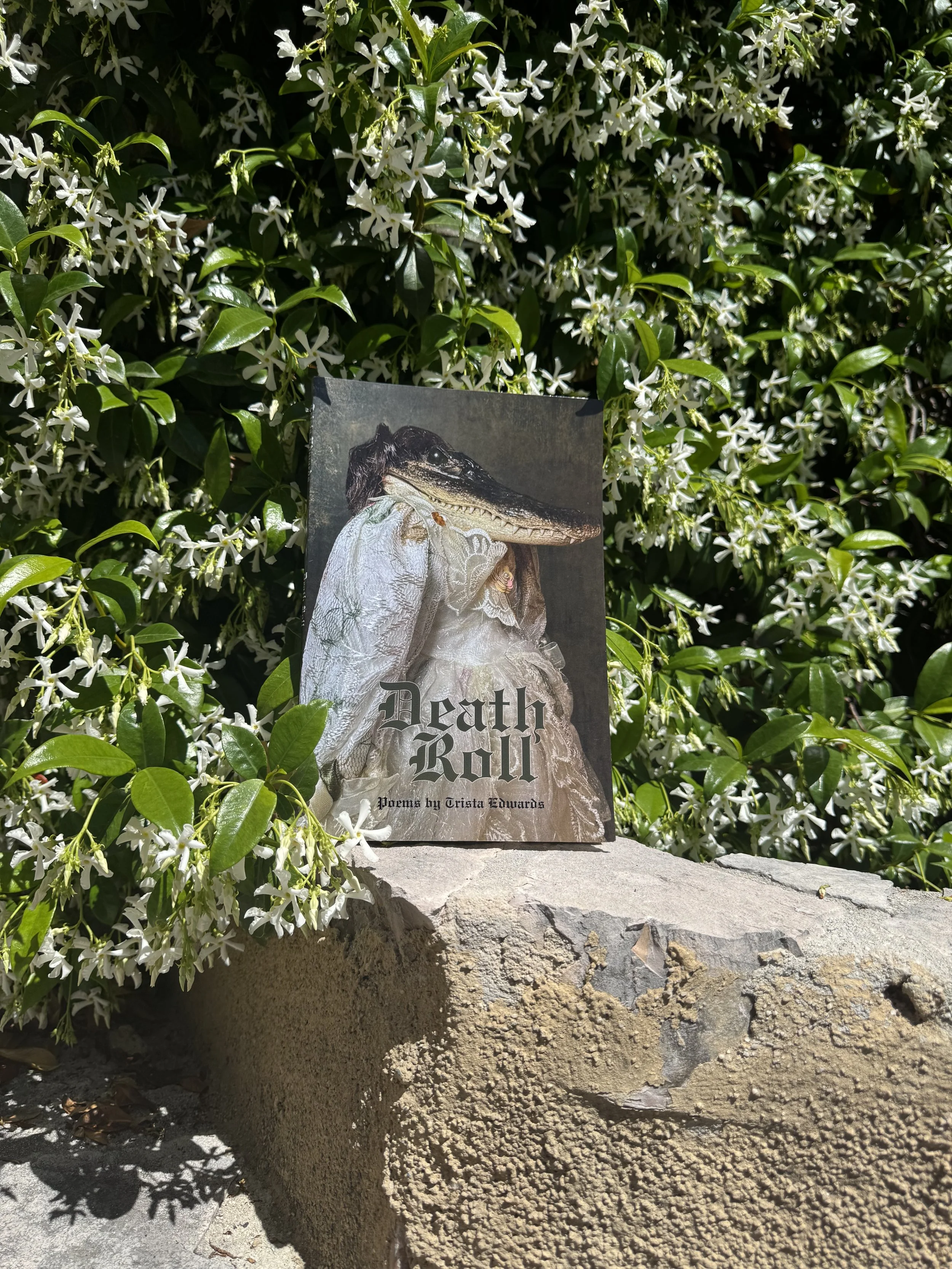
You are reading The Muck, a newsletter named after the imagined place where Ocala, the central figure of my collection Death Roll, was born: a fictional meat ranch in the gut of Florida. To be a writer is to live in that swampy ground, trusting that the most vital stories only emerge when you aren’t afraid to get your hands dirty in the "unpolished" parts of life.
Each month, I share my current terrain in three parts:
The Hatchling: Raw, messy dispatches from whatever project I’m currently coaxing into existence.
The Specimen Jar: A look at the strange objects and folklore fueling my creative obsessions.
The Bellow: A megaphone for the literary community and the work of my peers that demands to be heard.
Writing is rarely a clean or easy process. Most of the time, it’s a struggle—a messy, complicated effort to turn a raw idea into something that actually breathes on the page.
You are reading The Muck, a newsletter named after the imagined place where Ocala, the central figure of my collection Death Roll, was born: a fictional meat ranch in the gut of Florida. To be a writer is to live in that swampy ground, trusting that the most vital stories only emerge when you aren’t afraid to get your hands dirty in the "unpolished" parts of life.
Each month, I share my current terrain in three parts:
The Hatchling: Raw, messy dispatches from whatever project I’m currently coaxing into existence.
The Specimen Jar: A look at the strange objects and folklore fueling my creative obsessions.
The Bellow: A megaphone for the literary community and the work of my peers that demands to be heard.
The Hatchling: Immaculate Arrivals
Dearest Mucklings,
Over a week home now, and I'm still not entirely back. Earlier this June, I got on a plane to Italy. For years, two of my mentors and former professors, the founders of Convivio, had been inviting me to attend this unique conference in Umbria. And for years, I had been watching from afar—following along on social media, trying to decipher the kind of magic you can only really be present to experience. Babies, cross-state moves, personal loss, money, the general relentlessness of just living life—something always kept me from going. This was the conference's tenth anniversary, and something about that felt like a sign I couldn't ignore. So I finally took the leap.
Convivio is an intimate arts and literary gathering held at Castello di Postignano, a beautifully restored 10th-century hill town in the mountains of Umbria—the green, landlocked heart of Italy, a world away from the tourist pull of Rome or Florence. The attendees have the entire village to themselves for nine days. It is, in every sense, a place outside of ordinary time.
Getting there felt like it, too. A ten-hour flight suspended in timelessness, then three hours of bus climbing mountain switchbacks, the road corkscrewing upward like the landscape was trying to shake us loose. By the time we arrived, my body hummed with the frequency of travel. I was woozy, bone-tired, and slightly unmoored.
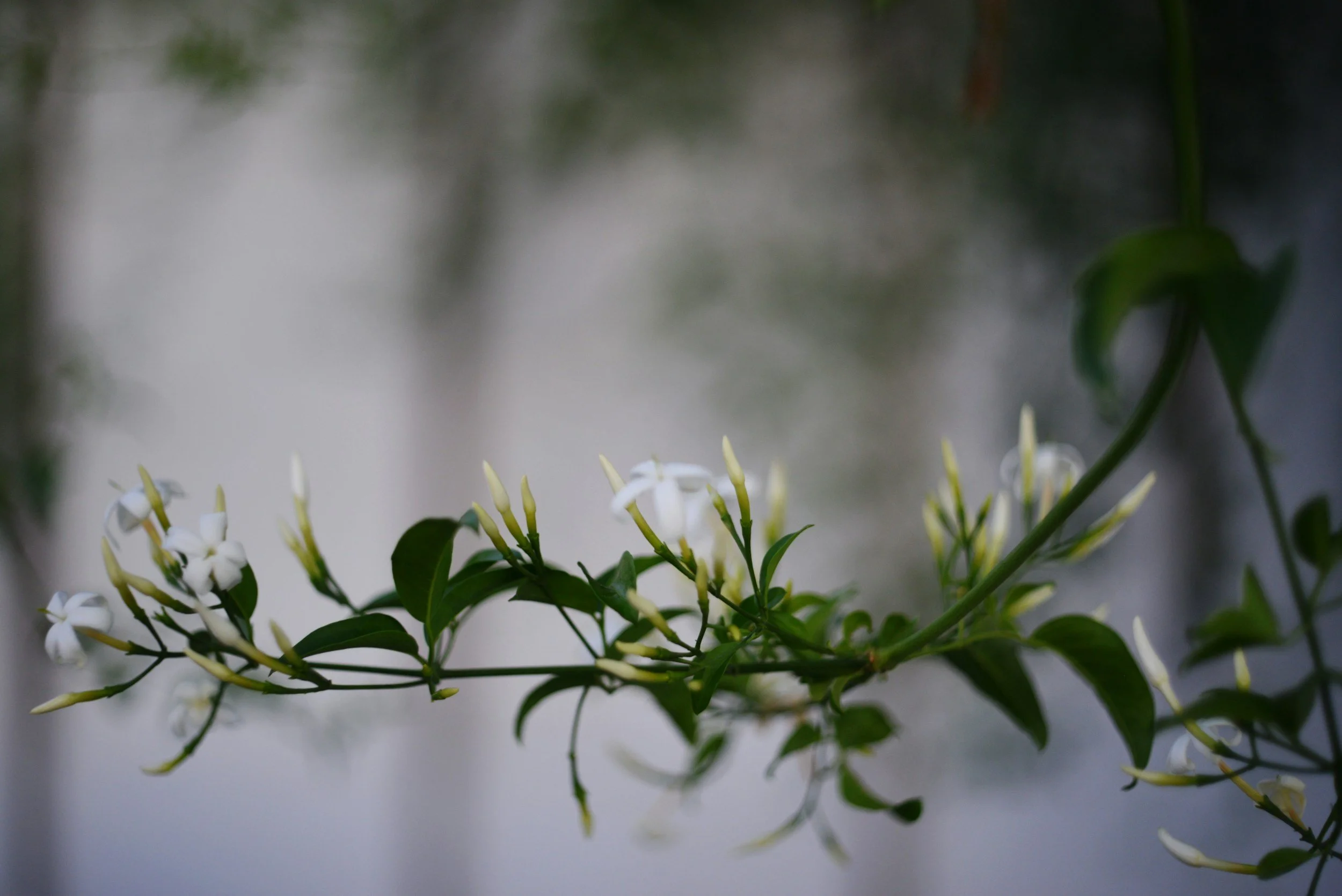
And then my foot met the ancient stone—the first step off the bus—and jasmine hit me like a wall. It was crawling up everything, spilling over the stone in every direction. Jasmine happens to be one of my favorite fragrances. It is overwhelming and welcoming all at once. Thick and intoxicating. The strangest part—it didn't smell like a foreign country. It smelled like home. It smelled like Georgia.
I wasn't prepared for that. Halfway across the world, and the jasmine didn't care. Standing there, jet-lagged and stunned, all I could think was: of course.
Scent is a constant for me—something I'm always tracking, even when I'm not paying attention. It's the invisible backbone of my current novel manuscript, and it was the core storytelling element of my former candle studio, Marvel + Moon, for years. It doesn't announce itself before it pulls you somewhere. It just goes ahead and does it.
That pull got stranger one night during an open mic inside the castle. Standing in a room with centuries of cold stone around me, jasmine drifting through the open door, I read poems about azaleas back home. The Georgia woods—humid, overgrown, specific to me as a fingerprint—arriving in full force in the middle of medieval Italy. It was uncanny and haunting, in the best way.
I didn't write much while I was there, but the pieces that did break through arrived from somewhere underground, and they arrived strange.
I managed two stanzas of the first poem I've written all year. It is, as it turns out, a collision between Cabbage Patch Dolls and the Annunciation. Cabbage Patch lore has gripped me for a long time. I've been circling it for years, writing scattered bits and fragments, sensing there was something larger living inside it—something that wanted to become a full poetry collection, though I could never quite locate the spine of it, the story I actually wanted to tell. The mythology was there, the obsession was there, but the direction kept slipping just out of reach.
I am not a Christian, but I have always been drawn to the raw power of Biblical myth, the way these stories operate on the nervous system regardless of belief. And wandering through a country so thoroughly steeped in Catholicism, how could this idea not find me? It arrived the way the Annunciation itself always does in paintings: sudden, uninvited, a visitation I didn't ask for and couldn't refuse. And with it, for the first time, a sense that I might finally know what I've been trying to say.
On the surface, the two have no business near each other. And yet the longer I sit with them, the more they bleed together into something singular and disturbing—a shared mythos of manufactured and miraculous genesis.
The Annunciation: a body chosen and altered without consent, a cosmic decision handed down like a fait accompli. Cabbage Patch lore: in the hills of Cleveland, Georgia, there is an actual hospital — Babyland General, but yes, also a gift shop — where soft-sculpture babies gestate within cabbage leaves, pollinated by BunnyBees carrying magic crystal dust from an enormous, glowing tree. Origin stories so aggressively whimsical they curdle if you look too long.
Both myths are obsessed with bypassed biology. Birth scrubbed clean of its ordinary human tangle and replaced by something mandated, inexplicable. The vessel—divine or domestic—is beside the point. What matters is the arrival. The fact of the thing, dropped into the world without asking permission.
There is something unsettling in how hard both stories work to make their narratives read like a miracle of arrival rather than a removal. I imagine this will be the core message I grapple with as I continue writing this poem.
I also made real headway on a travel essay I've been kicking around in my head for years — about Ireland, W.B. Yeats, and Xenomorphs. (The aliens. From Alien. Yes, really. More on that in a later folio.) You can see now, I hope, how my mind works. The seemingly divergent. The uncanny thing lurking just beneath the surface of something familiar. If you've been with me long enough—if you've spent any time in the swamp with me and my gator-doll— you already know I'll make this strangeness work.
No hemisphere is safe from my obsessions. And if anything, coming home has only made them louder.
I haven't been able to stop moving since I landed. That Postignano momentum has poured directly into two full-sensory lectures I’m pitching for next year's Convivio—fingers crossed the directors find them worthwhile.
The first, "Holy Rot & Jasmine: The Olfactory Archive of the Italian Saint," unspools directly from that moment my foot hit the stone. It explores the odor of sanctity—the strange historical phenomenon in which certain mystics were said to emit sweet, floral perfumes at the time of their death rather than the scent of natural decay. I'm pairing the science of indoles (compounds present in both decomposition and narcotic florals) with those miracle accounts, threading it all back to the Postignano jasmine that ambushed me on arrival. To make it fully experiential, I'm planning to pass out wax-sealed envelopes containing a pontifical fragrance designed for the Pope by Filippo Sorcinelli—master Italian tailor, perfumer, avant-garde visionary, and one of my favorite scent artists working today. He runs UNUM and is responsible for dressing the Vatican's high clergy. There is a staggering irony in the fact that a queer artist is the one weaving a subversive thread directly into the sacred vestments of the Holy See. Alongside the papal fragrance, I'm formulating a custom travel candle for the lecture: narcotic jasmine pressed against something dark and cathedral. History is not quiet text on a page. It is volatile and atmospheric. It demands to be inhaled.
The second pitch, "By Light of Gold and Ink: Reclaiming the Poetic Roots of the Italian Tarocchi," draws from a decade of personal Tarot study. It strips away the modern divination framework entirely to explore Tarot's actual secular origin — a luxury parlor game in 15th-century Northern Italy, used for collaborative, spontaneous storytelling. Renaissance salon guests played Tarocchi Appropriati: dealt a card, immediately challenged to compose micro-poetry that flattered or cheekily roasted one another. I'm designing a live, interactive version of this for the conference, where everyone will leave with a textured, high-resolution print from the historic Sola Busca deck.
I'm still unpacking all of it—the incense, the jasmine, the mountain air, the cold stone at two in the morning. Letting it do what it's going to do.
The Specimen Jar: Calamita Cosmica
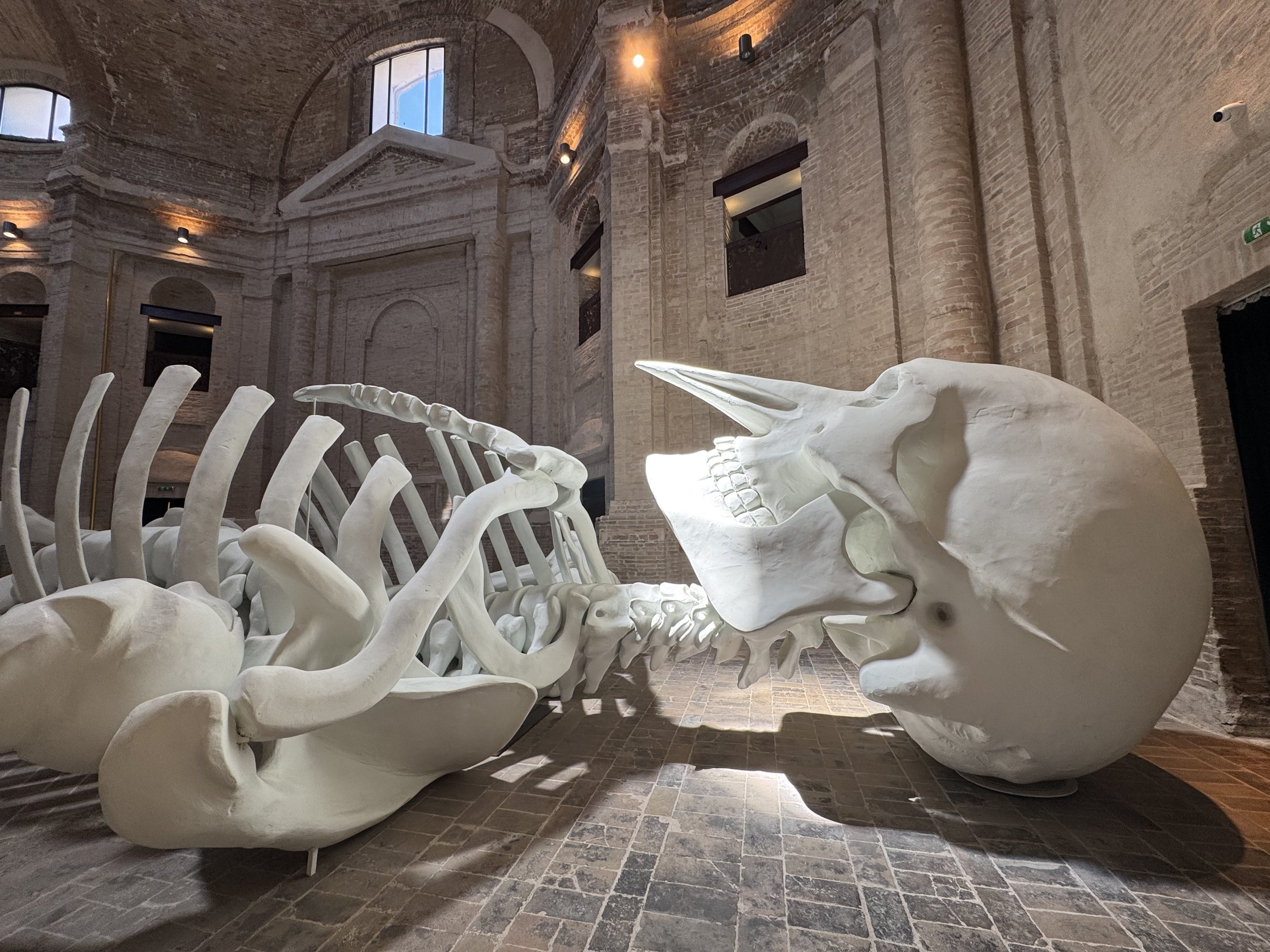
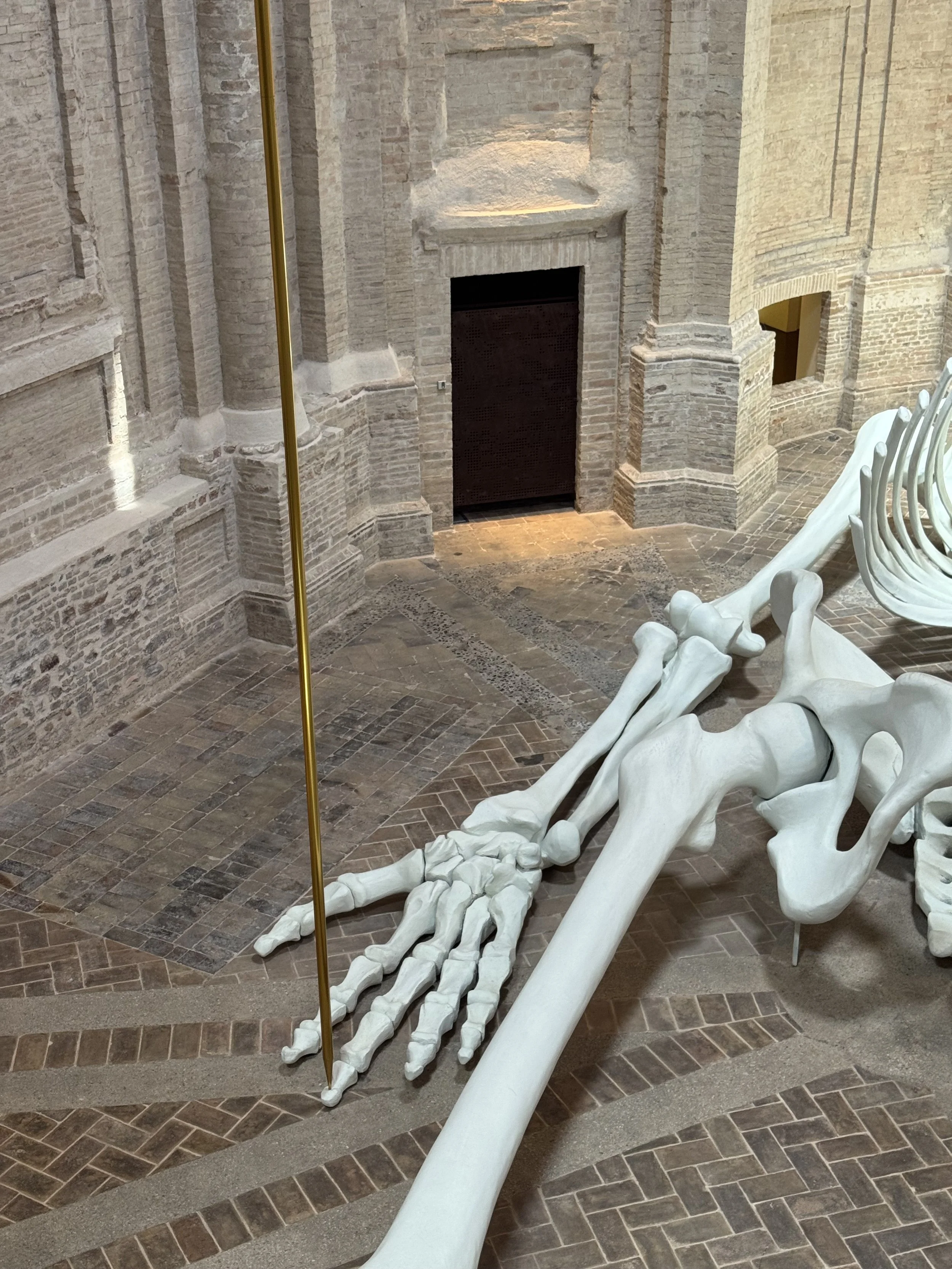
In Foligno, a short distance from Postignano, I had a breathtaking encounter with this month's specimen. Not a small object on a shelf, but a massive, jarring monument to the otherworldly: Calamita Cosmica—Cosmic Magnet.
The installation was created by the late Gino De Dominicis, an enigmatic and deeply provocative Italian artist whose entire obsession circled the same territory mine does: immortality, invisible forces, and the productive absurdity of trying to reach for both. Calamita Cosmica is a monumental 24-meter skeleton lying flat on its back inside an old church—anatomically correct in every detail except for the massive, elongated, bird-like beak protruding from its face. At the tip of one skeletal finger, it balances a golden cylinder: a magnet aimed directly at the cosmos, its purpose, as De Dominicis determined, to serve as a means of communication with the unseen.
That ancient, beak-nosed giant stretched across the stone floor beneath a domed ceiling, hit me with a visceral, grounding shockwave—the feeling of encountering something that had been quietly waiting, heavy and strange, long before I arrived and would be there, vibrating, long after I left. It felt like a physical manifestation of the exact kind of atmospheric archive I'm always trying to unearth in my own work.
The very next day after returning home from Italy, I ordered the Gino De Dominicis Reader. I have been trawling through the essays written about him (and some by the artist himself) ever since. And y’all, would you guess? He’s a stunning wierdo. He was committed to the unseen. He made invisible sculptures: a cube, a cylinder, both traced only as outlines on the floor, their volume implied but never there, like ghosts.
He built a mirror that reflected every surface in the room except the living people standing before it. The idea being that the objects remain while the living vanish. I am not out here putting myself on the shelf beside De Dominicis, butttttttttt I'll say this: Ocala, much?
My poetry collection was built on the same logic—Ocala was a mirror that observed the grief, the absence, the people who were no longer in the room. Which is maybe why his words hit me the way they did: “Drawing, painting, and sculpture are not traditional but original forms of expression, and thus also belong to the future.” I took this as his claim that the workout lasts beyond the body. That the invisible thing is often the most permanent one. I find that completely, painfully correct.
Needless to say, I am obsessed. I'm determined to get a woodcut-style tattoo of this magnificent Calamita Cosmica figure, even if the artist himself might disapprove of such a move. His beak-nosed giant is pulling at something in me—I suspect it will make itself known on the page when it's ready.
The Bellow: The Stacks
I am thrilled to recognize my White Stag press-mates who demand to be read. Please keep these brilliant collections on your radar for pre-orders and new releases:
As for my own nightstand, I am currently submerged in You Exist Too Much, the debut novel of Palestinian-American writer Zaina Arafat. I am reading it in preparation for Off Assignment's Writing Heartbreak, a month-long online course I am attending in July.
Since being back from Italy, my TBR has expanded. These titles are sitting in my cart right now, waiting for the right moment to come home: Scenting Salvation: Ancient Christianity and the Olfactory Imagination by Susan Ashbrook Harvey, The Odor of Sanctity by Joseph Roccasalvo, The Castle of Crossed Destinies by Italo Calvino, Monster Theory: Reading Culture by Jeffrey Jerome Cohen, and Fairies: A History by Francis Young. No theme there at all, right?
I am also participating in Caitlin Cowan's (Audio)Book Club over at PopPoetry, working through Emily Wilson's new translation of The Odyssey in preparation for the Christopher Nolan film adaptation set for release next month. For me, audiobooks are an act of pure optimism. I press play, I believe this time will be different, and my ADHD brain nods along for exactly as long as it takes to get distracted by its own internal overrun zoo. I have replayed the same passage so many times that I could recite it and still not know what comes next. But when your best friend does something cool, you show up. That's just the rule. I’m locking in with Wilson (and Claire Danes as narrator!) as best I can!
Go dig into these worlds and give them some noise.
Life is rarely perfect, and the creative process is even messier. But it's in the muck where we find the stories that actually matter.
Stay Ferocious Yet Tender,
Trista
P.S. If you haven’t yet, you can order your copy of my poetry collection, Death Roll, here. Ocala and I are forever grateful for your support!